
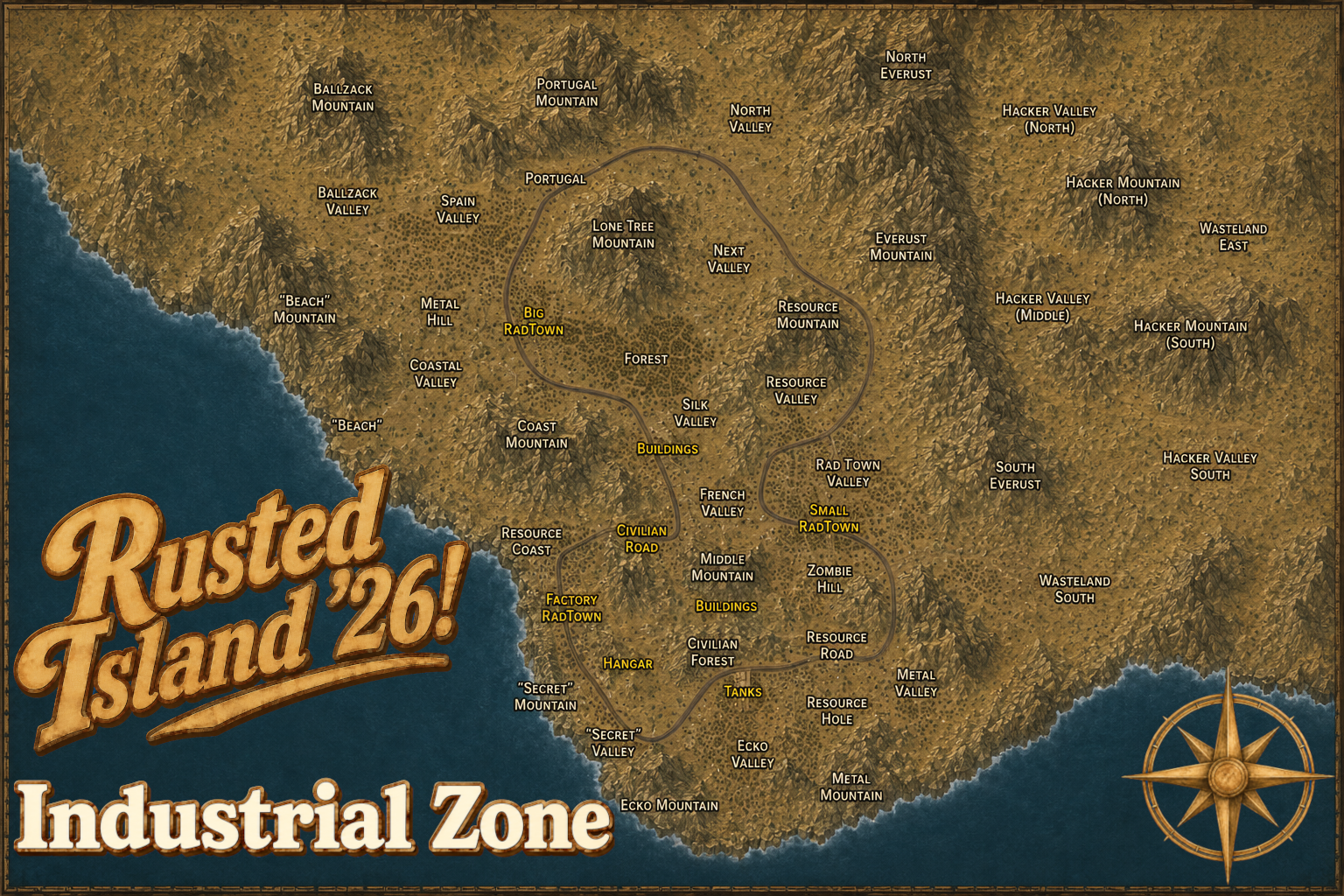
Read regions, not treasure marks
The illustrated map is meant for orientation: roads connect the interior, mountain and valley names help with callouts, and the highlighted built-up areas identify where a run changes from gathering to contested scavenging. It does not mark individual containers or promise what will be waiting when you arrive.
Map vocabulary: the map’s printed labels and familiar player callouts do not always match one-for-one. The guide keeps the active area names—Factory, Split Rad, Big Civ, Civ Two, Civ Road, Civ Mountain, Hangar, and Tanks—so squads can use consistent callouts.
Industrial Zone areas
Factory
The Factory Radtown landmark anchors the southwestern side of the road loop. Its industrial silhouette, multiple approaches, and open nearby ground make it easy to recognize—and easy for other survivors to watch.
- Run character
- Industrial and utility scavenging
- Plan for
- Radiation, exposed approaches, and competition
Split Rad
A compact named location near the southern interior’s branching travel routes. The surrounding road choices make Split Rad useful as both a destination and a place where separate teams can unexpectedly converge.
- Run character
- Mixed high-risk scavenging
- Plan for
- Short sight lines, route overlap, and a quick exit
Big Civ
The larger civilian location group. Treat it as a broad search area instead of one loot room: clear deliberately, remember your entrance, and expect movement between structures.
- Run character
- Broad civilian and general supplies
- Plan for
- Many angles, longer searches, and occupied buildings
Civ Two
A second civilian landmark group within the southern built-up region. It can serve as an alternate stop when the larger routes feel too exposed, but “secondary” never means uncontested.
- Run character
- General-purpose scavenging
- Plan for
- Nearby traffic and changing container availability
Civ Road
The civilian road group follows a natural travel corridor through the interior. It is useful for navigation and opportunistic stops, but road movement broadcasts direction more clearly than a wooded approach.
- Run character
- Roadside and civilian scavenging
- Plan for
- Passing players and limited concealment
Civ Mountain
A civilian location group shaped by higher ground. Elevation can offer information and cover, but it also creates skylines and makes a careless silhouette visible from farther away.
- Run character
- Route-based civilian scavenging
- Plan for
- Elevation changes, ridgelines, and slower retreat
Hangar
A distinctive southern landmark near the coast-facing side of the Industrial Zone. Large recognizable structures simplify callouts, while their entrances and open surroundings concentrate attention.
- Run character
- Industrial and combat-adjacent scavenging
- Plan for
- Watched entrances and exposed repositioning
Tanks
The Tanks group sits in the southern interior near several connecting routes. Its strong visual identity makes it a common reference point, so assume other players can orient toward it just as easily as you can.
- Run character
- Combat-adjacent and utility scavenging
- Plan for
- Converging routes and contested exits
How world loot should be read
World containers are randomized and temporary. Their appearance suggests a broad purpose, not a guaranteed item, quantity, rarity, or progression shortcut. A useful route is one you can survive even when every container disappoints you.
Wooden Loot Box
Think everyday survival and general scavenging. Useful early, never a promise of one specific resource.
Loot Crate
A mixed progression stop. Its value comes from possibility, not a fixed shopping list.
Ammo Crate
Combat-oriented expectations are reasonable, but neither ammunition type nor equipment is guaranteed.
Military Crate
A high-interest container worth treating as contested. Better potential also attracts greater attention.
Supply Drop
An event container delivered into the world. The aircraft, descent, and landing advertise the opportunity to everyone nearby.
Plan a loot run that can fail gracefully
- 01
Choose an objective
Decide whether the run is for general supplies, industrial progression, combat readiness, or map knowledge before entering a landmark.
- 02
Carry protection and an exit
High-interest industrial areas can combine radiation, hostile wildlife, and other survivors. Keep enough inventory room to leave early.
- 03
Use two route names
Give your team an entry callout and an exit callout—such as Factory toward Resource Coast—without relying on an exact container circuit.
- 04
Do not chase an empty route
An absent or emptied container is information. Change direction instead of waiting in the most obvious location.
Supply drops change the map temporarily
A supply-drop aircraft and falling crate create a moving point of interest rather than a permanent location. Watch the flight, terrain, and other players before committing. The best approach is rarely the most direct one, and reaching the crate first does not guarantee a safe extraction.